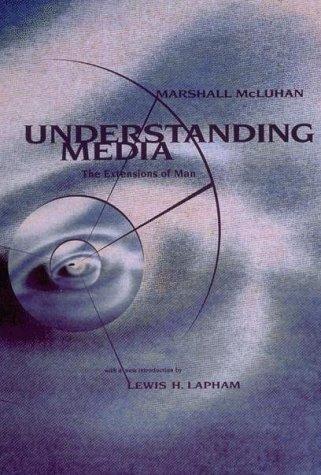
Understanding Media: The Extensions of Man
Marshall McLuhan. First published by McGraw-Hill in 1964. The 1994 MIT Press edition includes an introduction by Lewis H. Lapham and runs 400 pages.
Most people encounter Marshall McLuhan as a slogan. They repeat “the medium is the message,” translate it into “presentation matters,” and move on. That misses the force of the book.
Understanding Media asks a more difficult question: what does a technology change in the scale, pace, pattern, and sensory organization of human life before anyone has evaluated the content it carries?
A railway can carry grain, soldiers, tourists, or newspapers. Its most consequential effects do not depend on which cargo happens to be aboard. It changes the speed and geometry of settlement, work, trade, war, and time. Electric light has almost no content in the conventional sense, yet it rearranges the hours and places in which human activity can occur. The medium is an environment, not merely a pipe.
The decisive question is not only what a system says. It is what the system makes normal, possible, profitable, and difficult to perceive.
Architecture readout
- A medium extends a human faculty, then redistributes dependence across the rest of the person and society.
- Its message is the change in scale, pace, pattern, and association that the medium introduces.
- Every new medium absorbs older media as content while changing the conditions under which that content is encountered.
- Users adapt to environments before they can describe them. That perceptual numbness is part of the effect.
- McLuhan supplies a powerful probe, not a complete causal theory. Ownership, institutions, incentives, policy, culture, and resistance still matter.
- The tetrad is a useful later diagnostic developed with Eric McLuhan. It is not a framework introduced in the 1964 book.
What “the medium is the message” means
The phrase appears in the first chapter. McLuhan's point is not that content is meaningless. A lie and a truth do not become morally or politically equivalent because both arrive by television. Content affects knowledge, emotion, conduct, and consequence.
The point is that content analysis alone can hide the deeper transformation. While people debate individual programs, posts, or prompts, the medium is altering attention, authority, participation, memory, distance, and the possible speed of response. Those background changes can outlast any particular message.
What the claim illuminates
- Form and infrastructure have consequences.
- Speed changes which institutions can act in time.
- Scale changes who can coordinate with whom.
- Interfaces train attention and participation.
- Repeated use can make an environment feel natural.
What the claim does not prove
- Content is irrelevant.
- Technology acts without human institutions.
- Every user experiences a medium identically.
- A medium has one inevitable political effect.
- A clever analogy is empirical evidence.
That distinction is the difference between a serious media ecology and technological mysticism. McLuhan is strongest when he makes an invisible environment visible. He is weakest when a brilliant pattern is allowed to substitute for measured causation.
02 / Learn the operating conceptsSix ideas that carry the book
1. Media are extensions
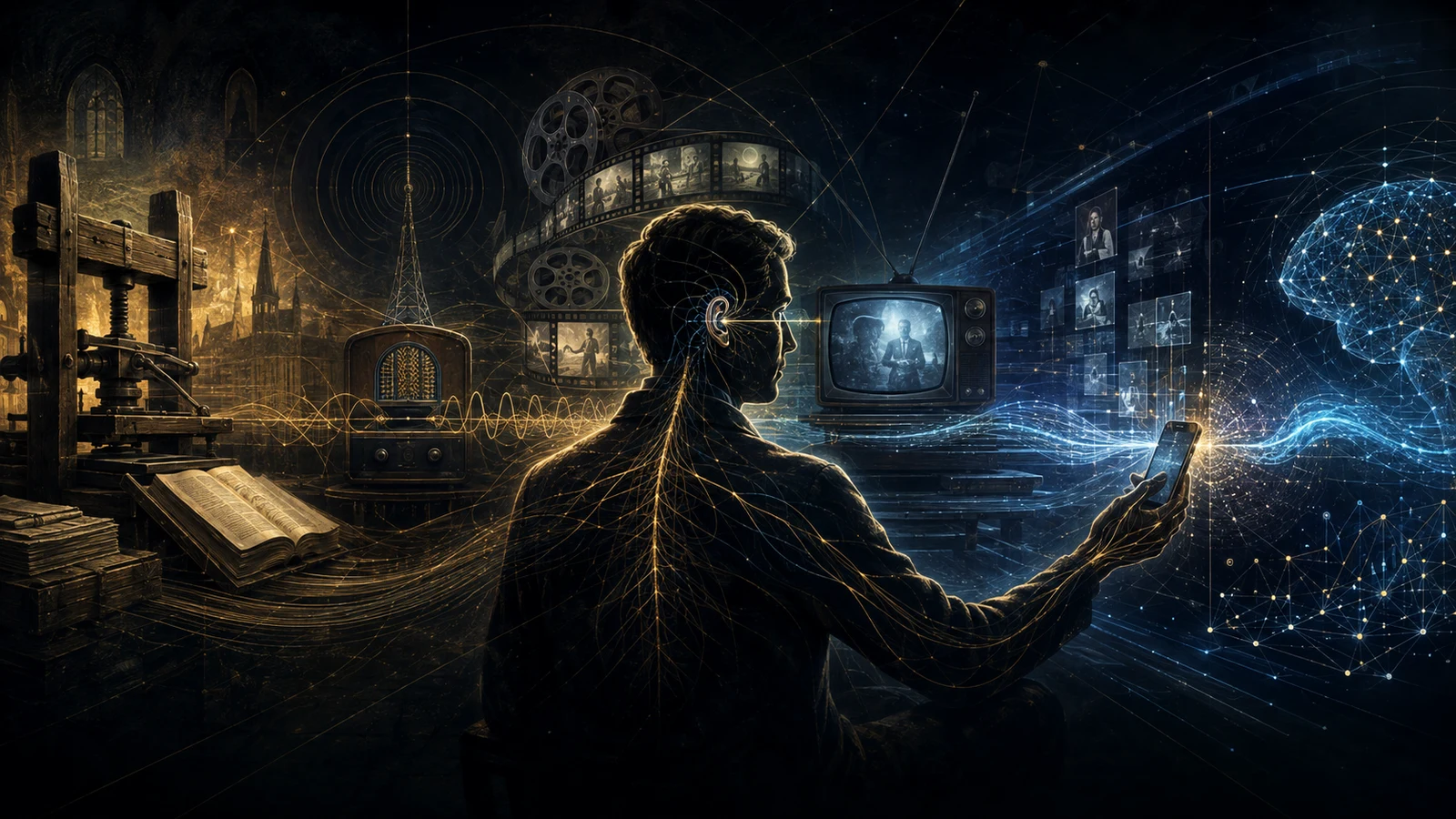
The wheel extends the foot. Clothing extends the skin. Writing extends speech and memory. Electronic media extend portions of the sensory and nervous system across distance. Extension increases reach, but it also redistributes skill, dependence, and vulnerability.
2. The message is structural change
Look for changes in scale, pace, and pattern. A platform that reduces distribution cost, collapses response time, and makes performance measurable has already changed the social system before any post goes viral.
3. One medium becomes another's content
Speech becomes the content of writing. Writing becomes the content of print. Print, photography, film, radio, and television become content inside the networked screen. The old form survives, but under new timing, incentives, interfaces, and feedback.
4. Participation has a temperature
McLuhan's hot and cool distinction sorts media by definition and the participation required to complete them. Treat it as a provocative heuristic tied to the media conditions of his era, not as a stable technical measurement for modern screens.
5. Extension can produce numbness
Chapter 4 uses Narcissus to describe a form of self-amputation and narcosis. The system protects itself from the shock of its own extension by ceasing to notice it. Habit turns a designed environment into background.
6. Electronic connection compresses involvement
The global village is not a promise of harmony. A village can be intimate, surveillant, conformist, conflictual, and difficult to escape. Distance collapses faster than human institutions learn to govern the resulting proximity.
The correction that matters now
Calling a smartphone “hot” or “cool” is usually less useful than decomposing the actual encounter. Video fidelity, interface friction, identity, personalization, reply mechanics, recommendation, payment, portability, and notification pressure can pull participation in different directions at once.
The content of a medium can conceal the medium
McLuhan observed that the content of a medium is often another medium. That insight becomes more useful in software because the visible surface can remain familiar while the operating relationship changes underneath it.
An AI chat interface appears to contain text. Yet the medium is not merely writing. It is responsive synthetic dialogue with low production cost, probabilistic generation, hidden model behavior, selectable persona, memory, tool access, and potentially delegated action. Reading the output as ordinary prose misses the infrastructure that produced it and the action surface behind it.
The same pattern appears in social platforms. The content may be journalism, family photography, comedy, scholarship, rumor, or state communication. The medium adds ranked distribution, quantified feedback, persistent identity, audience collapse, and real-time imitation. Those properties change behavior even when every individual post is accurate.
Standardized copies, delayed reply, portable linear sequence, editorial selection, durable citation.
Central transmission, synchronized attention, high reach, scarce channels, weak direct feedback.
Continuous publication, ranked visibility, quantified reaction, recursive imitation, audience measurement.
Adaptive dialogue, synthetic abundance, probabilistic output, personalization, tool use, delegated execution.
Where McLuhan is strongest, and where he is not enough
Strong: figure and ground
He directs attention away from the visible message and toward the environment that makes the message consequential. This is an excellent first move when a technology feels too ordinary to inspect.
Strong: second-order effects
He asks what happens to time, space, association, and sensory balance. That catches consequences that feature lists and content audits miss.
Strong: comparative imagination
By treating roads, clocks, money, clothing, games, weapons, and automation as media, he expands the field beyond newspapers and screens.
Limit: causal compression
Technology can appear to drive history by itself. In practice, material affordances interact with ownership, law, labor, business models, culture, institutional capacity, and user resistance.
Limit: aphorism as evidence
The prose is designed to provoke perception. Its analogies often generate hypotheses more reliably than they establish them. A pattern still needs operational definitions, comparison, and evidence.
Limit: unequal experience
No medium reaches a neutral universal person. Access, disability, class, race, gender, language, geography, and political power alter what an extension enables and whom it exposes.
The current University of Toronto Centre for Culture and Technology, which traces its origin to McLuhan's 1962 centre, explicitly combines his inquiry into the psychic and social consequences of technology with contemporary feminist, queer, decolonial, and antiracist approaches. That is not a rejection of McLuhan. It is an example of how the original probe must be expanded to examine institutions and differential power.
Evidence boundary
McLuhan did not simply “predict the internet.” His framework anticipated structural problems that become vivid in networked media. That is a meaningful intellectual achievement. It is not prophecy, and it does not make every modern application of his vocabulary correct.
The tetrad is not in Understanding Media
The four-part tetrad is frequently folded into summaries of the 1964 book. It belongs to McLuhan's later work with his son Eric and was published in Laws of Media: The New Science in 1988, after Marshall McLuhan's death. It can deepen the reading, but it should not be backdated.
The tetrad asks what a medium enhances, makes obsolete, retrieves from the past, and reverses into when pushed toward its limit. Applied to AI agents:
Enhances
Cognitive and operational scale: search, synthesis, drafting, coding, coordination, and execution at low marginal cost.
Obsolesces
Some routine drafting, routing, lookup, and interface labor. “Obsolesces” does not mean instantly eliminates. It means the older arrangement loses centrality.
Retrieves
The scribe, tutor, apprentice, operator, oracle, and conversational interface, now reconstructed through software.
Reverses
At saturation, assistance can become dependence; abundance can become verification scarcity; delegated agency can become action without an accountable principal.
This is an As Above interpretation of a later McLuhan tool. It is a disciplined way to generate questions, not a prediction made by McLuhan about contemporary models.
05 / Connect the Library to the fieldMcLuhan meets the PsyOp Series
The medium is not just the carrier. It conditions the target.
Part II of the PsyOp Series followed authority across monuments, coins, manuscripts, and print. McLuhan supplies the next analytical layer: each medium changes the audience, the tempo of response, the cost of reproduction, the visibility of feedback, and the form of collective attention.
A study of influence that inspects only the claim is therefore incomplete. It must also inspect distribution, identity, participation, latency, repetition, ranking, monetization, and the institutions that can alter the channel.
That does not make the medium a weapon by definition. A medium can support education, solidarity, discovery, care, or play. The same architecture can produce different outcomes under different incentives and governance. The point is narrower and stronger: the medium defines part of the possibility space in which influence operates.
This is why the McLuhan study belongs in the Library and in the foundation of the PsyOp sequence. It teaches the reader to look beneath the visible object without inventing an invisible conspiracy. Architecture can shape behavior without a central mastermind. Intent, design, emergent effect, and exploitation are separate questions.
06 / Use the bookThe nine-question media ecology audit
Use this field card on a platform, device, payment rail, AI agent, classroom, broadcast system, or political campaign. Answer at the level of actual mechanics.
Which human faculty or institutional capacity does the medium extend?
Which skill, dependency, intermediary, or local practice becomes less necessary or less visible?
What changes in scale, pace, pattern, access, memory, or association?
Which older medium appears as content, and what changes around it?
What must the user complete, supply, infer, disclose, or perform?
Which responses are visible, quantified, delayed, filtered, or impossible?
Who owns the infrastructure, sets defaults, ranks visibility, and captures value?
What does the benefit become when speed, scale, personalization, or dependence approaches saturation?
What comparison, interruption, art, measurement, or alternative design would make the hidden environment perceptible?
A useful discipline
Do not answer “the internet” or “AI” as if either were one medium. Name the specific stack: device, interface, model, identity layer, ranking system, payment mechanism, permissions, feedback, and social setting. Precision prevents McLuhan's vocabulary from becoming decoration.
How to read the book without getting lost
Begin with Chapters 1, 2, and 4
Read “The Medium Is the Message,” “Media Hot and Cold,” and “The Gadget Lover: Narcissus as Narcosis.” Mark every claim as observation, analogy, hypothesis, or evidence.
Choose three media you know from practice
Do not read all examples as equally authoritative. Compare his chapters on print, radio, television, money, or automation with your direct knowledge of one contemporary system.
Read The Gutenberg Galaxy beside it
The 1962 book provides the print-culture foundation. It helps explain why literacy, visual sequence, and typographic organization carry so much weight in the later work.
Add institutions and political economy
For every medium effect, ask who financed, owned, regulated, operated, resisted, and profited from the system. This is the correction McLuhan most needs.
Use the later tetrad only after the first pass
Enhance, obsolesce, retrieve, and reverse can expose a system quickly. Keep each answer falsifiable and label speculation as speculation.
Assessment
| Dimension | Score | Reason |
|---|---|---|
| Conceptual leverage | 10 / 10 | Few books teach figure-ground perception as effectively. |
| Historical importance | 10 / 10 | A foundational intervention in modern media theory and a continuing source of public language. |
| Empirical discipline | 6 / 10 | Generative analogies often outrun operational definition and proof. |
| Clarity | 7 / 10 | Memorable and provocative, but deliberately mosaic, recursive, and aphoristic. |
| Usefulness in 2026 | 9 / 10 | Essential for inspecting platforms and agents if paired with institutional, economic, and empirical analysis. |
Read McLuhan to perceive the environment. Then investigate the owners, incentives, institutions, users, and evidence that determine what the environment actually does.
The lasting value of Understanding Media is not that it supplies the final answer to television, the internet, or AI. It trains a better first perception. It asks us to stop staring only at the objects moving through the system and to examine the system that decides how quickly they move, who encounters them, what they demand, and what kind of person repeated use is helping to produce.
That is media literacy at its deepest level: not immunity from influence, but the ability to see the environment before mistaking it for nature.
Source register
Primary text and institutional sources reviewed September 5, 2026. Interpretive applications to platforms, AI, and PsyOp are As Above analysis.
- MIT Press, Understanding Media. Official edition metadata, publication history, and description.
- University of Toronto, McLuhan Studies: Understanding Media. Book structure and chapter sequence.
- University of Toronto Centre for Culture and Technology, Vision and History. McLuhan's institutional project and its contemporary critical expansion.
- University of Toronto Libraries, Marshall McLuhan Library Collection. Working library, correspondence, and marginalia associated with the writing of his major books.
- Library and Archives Canada, Marshall McLuhan documentary heritage. UNESCO Memory of the World recognition and archive details.
- Marshall McLuhan Estate bibliography. Publication chronology and the later development of the tetrads with Eric McLuhan.
- Human Technology, Volume 13, Issue 2. Scholarly editorial identifying “We shape our tools, and thereafter our tools shape us” as John M. Culkin's 1967 formulation. The common McLuhan attribution has been removed from this study.
Method note: This study distinguishes McLuhan's claims from As Above applications. It uses short titles and paraphrase rather than reproducing extended passages from the book. AI tools assisted research, image creation, and editorial production.
Read the environment before you inherit its conclusions.
Source-linked intelligence on agents, capital, consciousness, and the systems that shape agency.